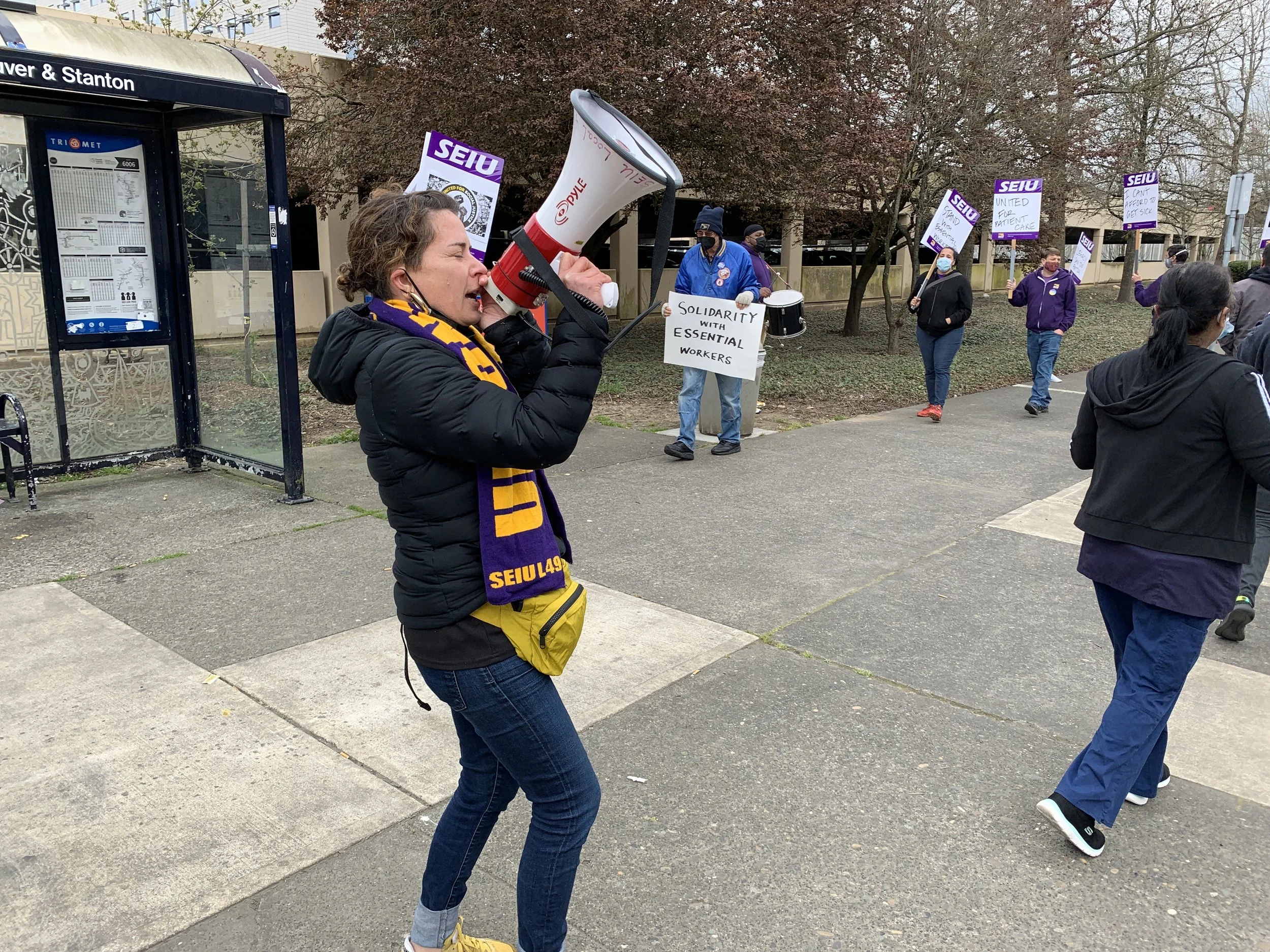
Legacy Has Failed to Invest in Its Employees, Fueling Labor Unrest
Legacy Health’s treatment of its workforce reveals a pattern of decisions that have resulted in money going toward executive pay increases and fines for wage and hour violations, rather than frontline worker wages, benefits and staffing. These choices have contributed to heightened employee unrest, as demonstrated by increased unionization and worker actions.
Legacy has Chosen to Invest in Executive Pay Rather than Its Frontline Workers
In recent years, the wages of some Legacy employees—such as dietary workers, certified nursing aides, and housekeepers—have fallen well behind competing hospital employers. For example, a certified nursing aide at Legacy Emanuel would have to work for 8 years to earn what a Kaiser Westside nursing assistant would earn on their first day on the job. Despite this, Legacy has refused to discuss mid-contract market wage adjustments for service employees represented by SEIU. These low wages have had appalling impacts on Legacy’s frontline service employees, including experiencing food insecurity or being unable to afford their rent or mortgage.
Legacy also cut essential staff to save money. For example, in December 2024, hospital management chose to lay off all night-shift certified nursing aides on medical surgical units at Legacy Emanuel.
Meanwhile, Legacy prioritized bloated executive salaries and overly generous exit packages. In FY2024, the previous president of Legacy Health, Kathyrn Correia, received a total compensation package worth $3.86 Million—more than CEOs of competing Pacific Northwest health systems of similar or even larger size earned.* Even more concerning is that, at a time of budget austerity, Legacy reported that Correia received a total compensation package of $2.54 Million the following fiscal year.** During that year, she was reported to have retired after working for three months.
Legacy Raised Costs on Their Own Employees to Balance the Books at PacificSource
In 2017, Legacy staff became involuntary customers when Legacy purchased an ownership stake in a local health insurer (PacificSource) and shifted all employee healthcare coverage to the newly acquired entity. Employees assumed this would mean their healthcare would become more affordable, but the opposite happened. An analysis of Legacy health insurance plan summary documents shows that over the next five years (2017-2021), employee health premiums rose more than 36% — about three times the regional average.*** This was not only expensive for employees, but disappointing as, in effect, Legacy was partially negotiating with itself over employees’ benefits, given that they were both purchasing the insurance as an employer and part owner of the insurance carrier.
Legacy Has Paid Millions in Fines and Settlements Related to Wage and Hour Violations
In 2017, Oregon’s Bureau of Labor and Industry (BOLI) levied the largest civil penalty in the agency’s history up to that point (nearly $277,000) on Legacy Emanuel for failing to ensure that employees were getting breaks. Some of the employees who submitted complaints in the investigation said they couldn’t even use the restroom for four hours or more.
More recently, in September 2024, Legacy agreed to an historic $14.5 million class action settlement to end a years’ long fight with current and former employees who alleged that Legacy failed to compensate them for work during unpaid breaks and before and after their shifts. Earlier that year, BOLI levied a $1.25 million civil penalty based on its findings that Legacy violated wage and hour laws at four Portland-area hospitals.
Legacy has Seen Surging Unionization in Response to Its Treatment of Employees
Labor issues have led to a surge in unionization in recent years. Legacy disclosed in its audited financial statements for the fiscal year ending March 30, 2024, only approximately 20% of employees were covered by a collective bargaining agreement. A year later, that percentage had more than doubled to 43 percent. And this number doesn’t even include the more than 800 workers that have unionized since the end of FY 2025.
*Legacy compensation as reported in FY2025 (April 1-March 31, 2025): Legacy Health System — Form 990, Schedule J - Nonprofit Explorer - ProPublica. Compared with CEOs from St. Charles Health System and PeaceHealth. Source: Peacehealth - Form 990, Schedule J - Nonprofit Explorer - ProPublica; St Charles Health System Inc - Form 990, Schedule J - Nonprofit Explorer - ProPublica
**Calculated as total compensation (Column E) minus compensation reported as deferred on a prior Form 990 (Column F). Source: Legacy Health - Form 990, Schedule J - Nonprofit Explorer - ProPublica
***The average increase in employee health premiums experienced by employees in the healthcare industry in the Western United States was 11.5%. Source: 2025 KFF Annual Employer Health Benefits Survey | KFF.Results were filtered to show healthcare employers in the West region only (AK, AZ, CA, CO, HI, ID, MT, NV, NM, OR, UT, WA, WY)